Royal Navy Brand
Evolving an iconic brand for a new generation
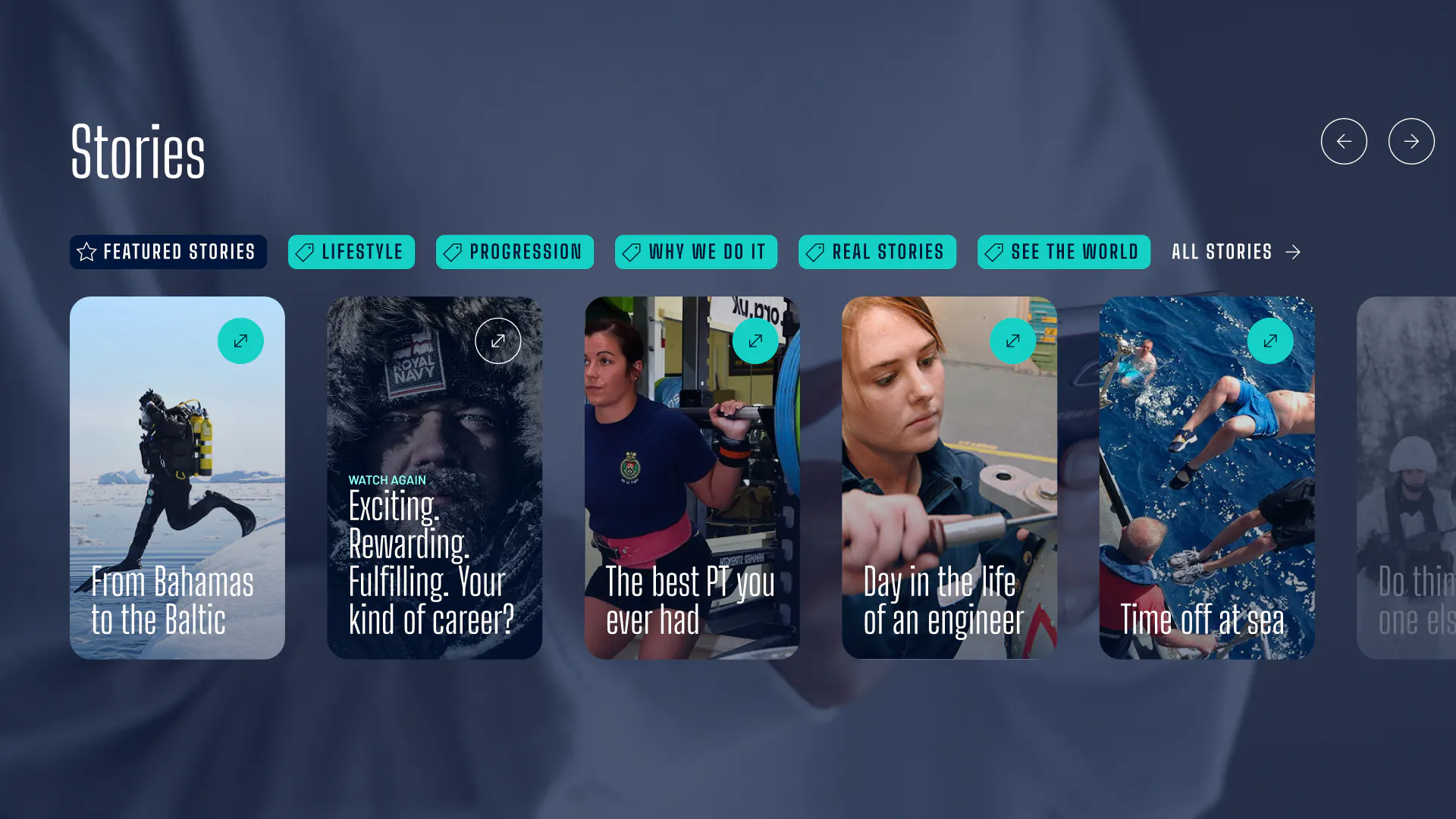
The Royal Navy is one of Britain's most historic and recognisable institutions, with centuries of heritage creating enormous equity in the brand: authority, service, purpose and a powerful sense of identity. Our challenge was to help that brand move forward without losing what made it distinctive.
It needed to adapt to remain relevant in a world of rapidly changing audience expectations, connecting with younger generations considering a career in the service while continuing to speak with authority to serving personnel, veterans, families, journalists, policymakers and the wider public, everywhere from websites, email and social content to signage, buildings, campaigns and official documentation.
This wasn't about replacing heritage with something new. It was about understanding which elements of the Royal Navy's identity were fundamental, protecting them, and finding new ways to express them.
Evolution, not revolution
We worked closely with the Royal Navy brand team and stakeholders across recruitment and communications to identify the attributes at the heart of the organisation, and where the existing identity needed to evolve. Our approach was deliberately evolutionary, retaining the authority and recognition built over centuries while extending and replacing elements of the identity to create a more progressive, flexible system.
The visual language drew directly from the Royal Navy itself: navy blue from uniforms, gunmetal grey from ship hulls, and a distinctive radar teal inspired by the technology used at sea, alongside a bold new primary typeface, 'Big Shoulders', reflecting the angularity of next generation ships.
One brand, many audiences
One of the biggest challenges was range. The Royal Navy needs to inspire a teenager considering a career in the service while retaining credibility with a veteran of decades' service, and to communicate with families and serving personnel as well as journalists, policymakers and other influential audiences. The answer couldn't be to simply make the brand feel younger: we needed a system with range, capable of becoming more expressive when engaging potential recruits while retaining the gravitas required for corporate, operational and official communications, and just as powerful on a social post as on the side of a building or within an official document.
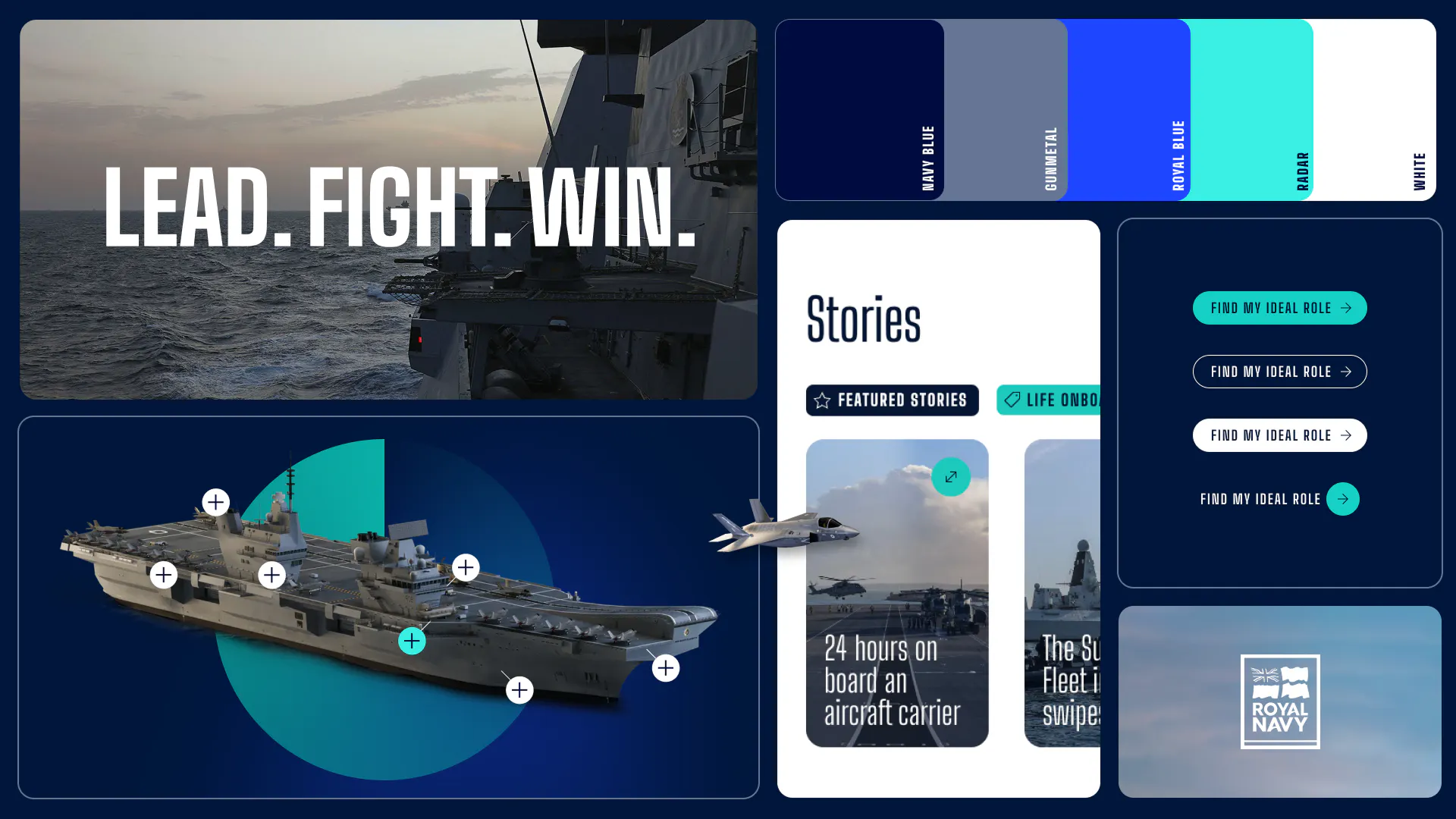
A system for a family of brands
The complexity went further than audiences and channels. The Royal Navy isn't a single, simple brand, it has a wider family of identities that need their own character while remaining recognisably part of the whole.
The Royal Marines was particularly important: not a conventional sub-brand sitting beneath a master identity, but one with an incredibly strong identity, history and culture of its own, so our system needed to accommodate that distinction rather than flatten it. We developed the identity to flex across both the Royal Navy and Royal Marines, balancing shared brand principles with the elements that make each distinctive.
We've since extended that thinking to Navy Sport, evolving a sub-brand grounded in the master brand but designed for its own context and audience: we gained consent for an additional colour inspired by premium athletic clothing, and a more kinetic typographic style, to give it greater dynamism while keeping the characteristics that connect it unmistakably back to the Royal Navy. The key principle throughout was understanding what needed to remain consistent, and where there was permission to flex.
A brand designed to keep evolving
That's one of the most important outcomes of the work: a brand system capable of responding to different audiences, channels and parts of a complex organisation. It can dial up expression for recruitment and younger audiences, carry the authority needed for corporate and official communications, accommodate an established identity such as the Royal Marines, and provide the foundations from which identities such as Navy Sport can evolve for their own audiences.
The result is freedom without fragmentation. The Navy can continue to evolve how it presents itself while retaining the heritage, recognition and coherence of the organisation at its heart. For an institution with centuries behind it, progress didn't mean starting again, it meant knowing what to protect, what could flex, and creating a system capable of carrying the brand confidently into whatever comes next.